
This summer’s idiosophical conceit is that the novelist Charles Williams 1 communicated pointers to occult rituals in his novels in concentric circles, mimicking the degrees of initiation into a secret society. That he put hints of his occult practices into his novels is well established. (See for instance, the introduction section of Gwen Grant’s 2021 paper.2) What I’m looking at is the structure of how he did so. If this idea checks out, the books will show stylistic or structural features arranged in three levels.
As an initial hypothesis, we could look for a structure like
- The Outer Circle: A reader who knows nothing about the occult3 can read the novel as a murder mystery or an Indiana-Jones-style adventure story and not worry about it. But a reader who’s interested can find clues that there’s something deeper in the book, if they’re willing to dig. This is obviously true — is it done by machine-detectable stylistic cues?
- The Initiate: Williams’s novels are “an attempt at active communication of an established body of knowledge in symbolic form.” 4 Some occult symbols aren’t as obvious as an ancient relic or an alchemical formula. Esoteric practices were popular in Victorian England; in the 1930s and 40s memories remained as cultural touchstones. Collecting a list of these and searching for their presence in the text could reveal patterns. I’m not talking about the object of power that activates the plot. Rather, there will be tools or ideas that the characters use to get out of the plot alive.
- The Adept: Each novel has a character who possesses an inner tranquillity that gives them almost supernatural power over events. Sørina Higgins calls them “jedi masters“. Perhaps these characters personify the innermost circle.
The singular feature of this hypothesis is that the inner circles have already been done, to a great extent. Previous scholars have written entire books about the cool parts. Grant: “Gavin Ashenden’s Alchemy and Integration (2006), which focuses on alchemical symbolism in Williams’ novels and, more recently, Grevel Lindop’s biography Charles Williams: The Third Inkling (2016), which provides a fully integrated discussion of Williams’ occult activities alongside the other events of his life. Aren Roukema’s Esotericism and Narrative (2018) has continued this exploration to include Kabbalistic symbolism, the role of the imagination, and specifically the influence of The Fellowship of the Rosy Cross rituals in Williams’ novels.”
So all I have to do is the first stage. Williams is famous for “the obscurity of his prose style.” It’s reasonable to suppose that the more obscure parts of the books are a signal to the reader that a deeper meaning lies beneath. Can we measure obscurity? That would have to be defined specially, but maybe complex occult ideas require complex writing. We can measure complexity of a text with canned algorithms. There are lots of them. Probably the most famous is the Flesch-Kincaid formula that measures the effective “grade level” of a text.
Figure 1 shows the results if we break up all of Williams’s novels into chapters and measure each one separately. There’s a magenta dot for Williams’s chapters. Dots in other colors are measurements of four comparison novels from the same historical period: two adventure stories and two murder mysteries. The adventure stories are Captain Blood by Rafael Sabatini and Meet the Tiger by Leslie Charteris (the first story about “The Saint”). The mysteries are The Murder at the Vicarage by Agatha Christie (the first “Miss Marple” story) and Clouds of Witness by Dorothy L. Sayers (a “Lord Peter Wimsey” story). I guessed that an obscure novelist like Williams should make a clear contrast with pop-culture fiction. I was wrong.
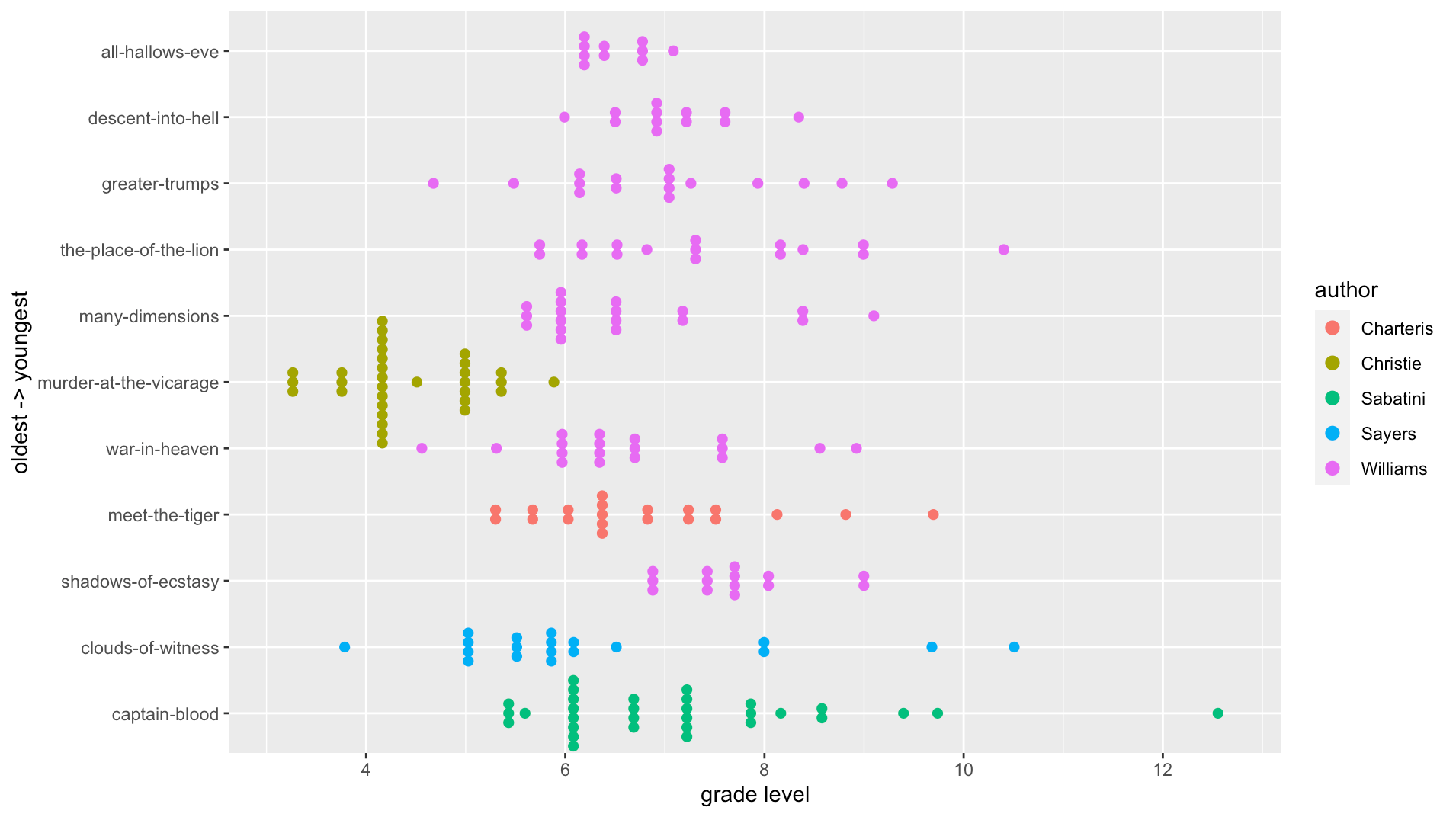
Fig. 1. Chapter-by-chapter reading grade level
All the novels vary from chapter to chapter in the complexity of their prose, but some trends are clear. The Miss Marple story is the easiest to read, with its chapters tightly bunched between 4th and 5th grade. Lord Peter Wimsey is second easiest.5 The two adventure novels are indistinguishable from Williams’s novels using this measure. That’s going to take some explaining. Another unexpected thing: note that Figure 1 is sorted by writing date — Williams’s later novels are written at a lower grade level than he used earlier in his career.
At one level, this is easy to understand. Before the occult came into the calculation, Charles Williams wanted to make money by selling books. Charteris and Sabatini sold very well a few years earlier, so it makes sense to follow their lead. Shadows of Ecstasy was written first, but War in Heaven was published first. It’s easy to see the shift to simpler writing between the two; the difference may have been important to the publisher.
Looking a little deeper, it would be useful to have a more direct metric for comparison. We find that when we restrict ourselves to novels from a short period in one place, lots of the ways to measure complexity of a text agree with each other. For this sample, grade level is 99% correlated with sentence length, which is much easier to calculate, so let’s switch to that. It turns out that averaging over chapters makes us miss an important feature of Williams’s prose style. Most of the time, Williams writes very directly. Here’s a randomly-selected paragraph, from The Place of the Lion, ch. XIV:
She went into the kitchen and made herself some sandwiches, considerably to the maid’s astonishment. She even attempted a little conversation, but she was feeling so shy that it was not altogether a success. The maid, she realized, was very much on her guard. That was the kind of world that Damaris Tighe had hitherto insisted on making all round her, a world where people were watchful and hostile. She looked at it humbly while she finished the sandwiches; then she went upstairs to her father.
While not as simple as Christie’s prose6, this is easy to read, and it’s what Williams does most of the time. But occasionally he cuts loose. Figure 2 shows what I mean. It shows Meet the Tiger and The Greater Trumps together. The horizontal axis is the number of words into the novel. The vertical axis is the average sentence length, where the average is computed over a sliding window 1000 words wide.

Fig. 2. Rolling average sentence length in two novels.
The Saint’s adventures are documented with a steady sentence length of 20-25 words, with occasional sallies that stretch sentences out 30 or more, usually for humorous effect.7 Williams, indicated by the red curve, mostly uses paragraphs of short sentences, but these are punctuated with occasional sallies into epic verbosity. That giant spike was caused by a 242-word monster of a sentence, describing a box of marionettes corresponding to the cards of the tarot.
So this is the first place to look. The next step is to correlate the long sentences with some more intuitive marker of occult content.
Notes
- Notorious victim of the entry barrier to literary research
- Grant, Gwen. “Sound and Ritualistic Language in Charles Williams’ War in Heaven.” Aries, vol. 23, no. 2, Dec. 2021, pp. 169–205. DOI.org (Crossref), https://doi.org/10.1163/15700593-20211006.
- On account of it being occult.
- Grant, p. 182
- After I deleted a couple pages of French that the computer marked as “rare words”.
- I gave a little shriek; it sounded so awful, and then–the person laughed. Laughed! Distinctly. And that was all. I heard him hang up the receiver.
- One paragraph I recall, from much later, began “The present writer, whose Spartan economy of verbiage can not have escaped the notice of even the least attentive reader, …
Sørina Higgins
This is marvelous, and you are brilliant. BUT… as we’ve discussed, I don’t think that “complexity” or “difficulty” is going to be measurably by any of these methods. Here are some reasons.
1. It doesn’t matter how simple the words are if the *concepts* to which they refer are difficult to understand. Even in the random passage you chose from Place of the Lion, the *way* in which Damaris has made the world cold and hostile is challenging to comprehend: She has studied philosophy as if it is a mere intellectual field without any viable spiritual content, whereas really (according to CW) a serious study of philosophy demands that you believe in God and serve others, or else the divine Pterodactyl of Corruption might break through your window and stab you in the heart.
2. Sentence length might be a better measure than mere vocabulary, but what about sentence *structure*? I find that weird, convoluted syntax is much more difficult to comprehend than sentence length, because a long-but-simple sentence is easy for the brain to break up into clauses. Even ambiguous pronoun antecedents can create challenges.
3. What about complexity of reference and ambiguity of pronoun reference together? Take this clause from your example: “She looked at it humbly while she finished the sandwiches.” I suppose the antecedent of “it” is not really ambiguous, but it’s weird: it’s “the world,” i.e., the world Damaris has made for herself. If CW meant that merely the way we do when we say it casually (“Oh, they’ve made up a whole world in their heads”), that would be simple, but he means it phenomenologically: like, we *actually create worlds* by how we think and what we imagine. And–Oh, wait! look!–that’s an occult concept. By performing focused meditations, we can create realities on the astral plane which then in turn create realities on the material plane. Ding ding!
4. Chapter-by-chapter analysis might obscure some important complexities that exist on the level of narrative structure. Let’s use Nolan’s Odyssey as an example. I’ll bet the screenplay would come out pretty low on the Flesch-Kincaid grade level. I mean, people don’t talk much, for starters, and when they do, it’s in quite colloquial 21st-century American English. However, the *timeline* is all over the place. Odysseus might be with Calypso on her island, talking about his family, then he might be in the wooden horse whispering to his men, then he might be back in his youth choosing a hunting-dog pup, then he might be in Polyphemous’ cave, etc. You get the idea. Time is non-linear in that film, which means the audience has to do some brain work to keep up. But that type of complexity wouldn’t show up in mere vocabulary choices.
Joe
You’re right, of course. Your definition of sentence structure is 93% correlated with sentence length, so it will give similar results, but pronoun references are much harder. (meaning, I don’t know how I’d do that.)
I’m trying to find out if the text contains what poker players call “tells”: stylistic quirks that CW uses when he’s hinting at occult secrets. If we don’t know all the hidden secrets ourselves, cataloguing those might reassure us that we’ve found them all.
Stephen Winter
I am reading War in Heaven at the moment and working on it in my own “Wisdom from…” kind of way. So when I received an email from you with this title I was intrigued.
I have no doubt that Williams knew exactly what he was talking about when he described occult practices. In fact I feel the need to pray when I read certain chapters. I have no desire to become more adept than I already am in regard to what Giles Persimmons knows.
But I am drawn to Julian Davenant. He possesses that inner tranquility you describe really well here. As the story develops in War in Heaven he goes deeper into the wisdom of his own tradition. The real work is done by the highest authority that he serves as is shown in the Prester John character in the story.
Joe
Hi, Stephen! Since I’m positively inclined towards fencers in general, I agree that Archdeacon Davenant is an interesting character. I don’t think he knew he was the hero until Chapter X or so.
Stephen Winter
I am absolutely sure that you are right in saying that Davenant has no idea that he is a hero, despite Mornington declaring him the Galahad of the story.
Don Gauger
Joe, what a fascinating analysis. In terms of Information Design, your outline highlights many concepts basic to good writers and knowledgable English professors. These are concept relationships that the rest of us might have missed.
“A physicist loose among the liberal arts” indeed!
I like Sørina’s comments, which add context and depth to many of your points (in her wonderfully humorous way). I would just add that Quantum physics suggests that our free will actions do create new branchings in time/space, so in that sense our intentions do create or manifest reality. That may really be more science than mysticism.
Joe
It’s almost like you’re reading the drafts of upcoming posts.